
Have you ever thought deeply about what you're actually working for — and what work really means to you?
Is your working day just something to endure until the next payday, or a day where you feel a little better than yesterday?
In my review of Growing Together back in July, I wrote that sometimes you need to change your environment in order to stay immersed and keep growing. Fortunately, I recently landed a new job, and starting in October I'll be continuing my work somewhere new.
Before my start date, the new company sent me a book as a gift, suggesting I read it before joining. The book: Why Do We Work: The First Question You Should Be Asking Most Passionately Right Now by Kazuo Inamori (Dasan Books, 2021).
I'd seen it introduced on "면접왕이형" (a Korean YouTube channel on job interviews and careers) that I used to watch regularly, and I'd heard the phrase "Kazuo Inamori, the god of management," so it had been on my someday-I-should-read-this list. As luck — or fate (?) — would have it, the perfect excuse to read it landed in my hands. So I want to write down what I felt while reading it closely, and the thoughts that came up when I asked myself the same questions I opened with.
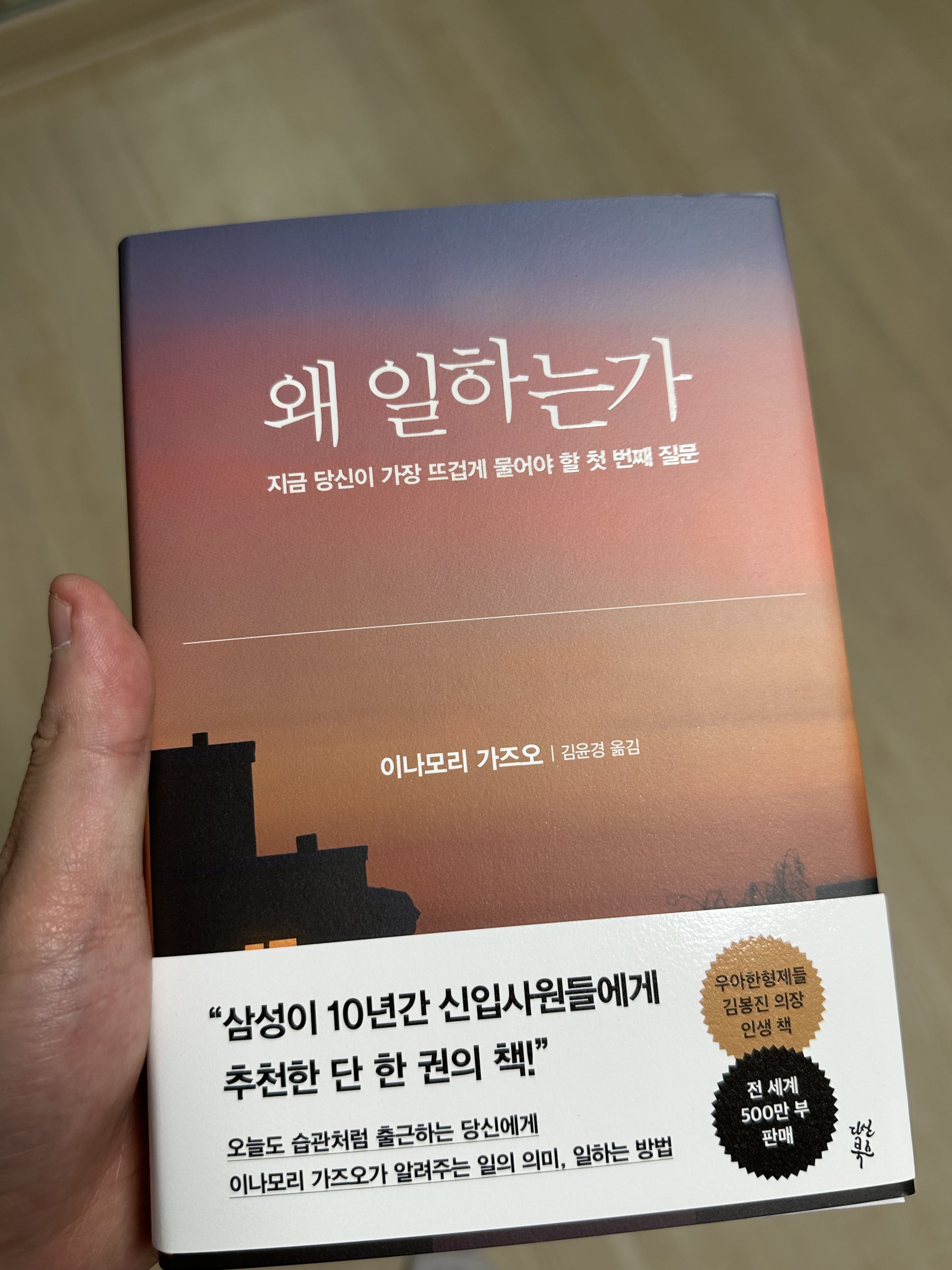
About the Book
First, the author. Kazuo Inamori founded Kyocera — now a global company — at the age of 27, and later founded KDDI, today Japan's second-largest telecom carrier. In 2010, he took over as unpaid chairman of Japan Airlines (JAL), which had gone bankrupt, and got it relisted in just two years and eight months. That track record earned him the title "the living god of management."
Before diving into the review, there's one thing I want to point out.
This book does not offer a methodology for 'how' to do your work well. Inamori emphasizes that success or failure at work starts not from 'how' but from 'why', and, as someone who dug the same well for nearly 60 years, he offers his own answer to the question "Why do we work?" And at the heart of that answer is the value of self-discipline through work.
Through six themes, each framed as a question, the author shares his philosophy from multiple angles.
- Why do you work? — The fundamental meaning of work
- Do you love your work? — The mindset of throwing yourself completely into it
- What do you dream of? — A dream so earnest it reaches your subconscious
- Do you keep making the effort? — The power of persistence that turns the ordinary into the extraordinary
- Are you satisfied with the present? — Pursuing perfection, where even 99% falls short
- Do you work creatively? — The attitude of making today different from yesterday
The book closes with an epilogue, "The Equation of Life That Opens Tomorrow."
Book Review
Chapters 1–2. Why do you work? → What am I actually working for?
Looking at Inamori's early career as described in Chapters 1 and 2, he gradually stopped seeing work as just a way to make a living, even in tough circumstances. After graduating from an unremarkable regional university, he barely managed to get a job at Shofu Industries through a professor's recommendation. The company was on the verge of collapse, and no one at the lab paid much attention to his work — yet as he learned the fine ceramics process with his own hands, he redefined how he approached work.
It was a mindset of seeing work as an opportunity to cultivate character and grow on the inside — something that, even when it brings hardship, gives back more joy and pride than it takes.
As section titles like "Earnest immersion changes your life" and "No happiness comes for free" suggest, the author conveys an insight throughout Chapters 1 and 2: the perspective you bring to your work environment, and how much passion you pour into it, is exactly what determines "what you're working for."
Chapter 2 in particular goes a step further, urging you to love your work and throw yourself into it completely. Through section titles and episodes like "Change your mindset first," "With enough affection to want to hug the product," and "Become a person who sets themselves on fire," Inamori's message comes down to this:
Not waiting for someone else to light the fire, but becoming a person who ignites and acts on their own — a self-igniting person
His metaphor of dividing people into non-flammable, flammable, and self-igniting types was fun, and I found myself nodding hard at what each one stands for.
I suspect most people, myself included, see work mainly as "a way to make a living."
But lately I'd been feeling more and more that when you approach work not just as a paycheck but as a form of self-cultivation and self-development, everything shifts — your interest, your focus, your sense of accomplishment, and even your productivity.
While preparing for my job change, whenever I was self-motivated, the work became enjoyable without anyone telling me to do it, and better efficiency and output followed along with it. And while juggling AI study and side-project development, setting goals, designing first, and then solving things one by one gave me a strong sense of accomplishment and a real feeling of growth. It made me think that the "person who sets themselves on fire" Inamori talks about isn't something grand — it might be exactly that state.
So, reflecting on who I used to be, I found myself taking stock of the skills and attitudes I'd been lacking, and resolving to fan the flames even more so I can keep igniting on my own.
Chapters 3–4. Dreams and persistence → It all comes down to your mindset
In Chapter 3, Inamori says a dream shouldn't stop at a vague wish. It has to be so earnest that you think about it 24 hours a day, to the point where it shows up in your sleep — it has to reach your subconscious. He explains that even opportunities that look like coincidence are, in fact, the inevitable result of staying absorbed in something for a long time.
Chapter 4 finds the power to turn the ordinary into the extraordinary in persistence. Making today count, and taking one more step than yesterday. As section titles like "The moment you want to give up is a new starting point" and "There's nothing you can't do — only things you don't do" suggest, Inamori says consistency is what ultimately makes the difference.
This was back when Inamori, after founding Kyocera, was struggling to make fine ceramic products that met his clients' demands. He says he had an epiphany when he heard Konosuke Matsushita, chairman of Matsushita Electric (now Panasonic) and known at the time as the god of management, answer an audience member's question at a lecture with "Well, then you just do it." Going through endless trial and error until no defects come out, and achieving it by refusing to give up and continuing to try.
In the end, Inamori came to realize the importance of realistic dreams (goals) and persistent execution in his work, and gradually got onto the path to success.
Looking back, I think I've said something similar to myself every time I went through a hard stretch in life. Just get back up instead of falling apart. Just decide that you can. Just dream earnestly of what you want to achieve. Reading this episode, it struck me anew that getting through those moments one at a time is how I became who I am today — and it helped me pull myself together once again.
Chapter 5. Are you satisfied with the present? → Am I settling for 99%?
In this chapter, Inamori says that even 99% isn't enough, because a mistake can't be rubbed out with an eraser. He stresses that work should be perfect enough to 'cut your hand,' and that what you should pursue is not the best, but the perfect — not something better, but something that can't be improved upon. He drives this message home repeatedly in sections titled "Even 99 percent is not enough," "The smaller the matter, the more careful you should be," and "Dream not of the best, but of the perfect."
Reading Chapter 5 felt like being called out the entire time... Until now, I'd been settling at work, telling myself "99% is good enough" and "doing as well as everyone else is already doing well." It made me seriously ask whether that settling had been drawing my own limits for me, and getting in the way of both my growth and my interest in the work.
Especially in development, I think it's better to aim for a flawless, bug-free implementation. In that case, shouldn't the standard be "no mistakes" rather than "as good as everyone else"? Reflecting on that, I made up my mind to pursue not the best, but a flawless kind of perfect.
Chewing over all those moments where I settled with "99% is enough" and putting them behind me, I want this review to hold a resolution: at the very least, I won't be the one to draw my own limits first.
Closing
In Chapter 6, which I didn't cover separately in this review, Inamori talks about a creative attitude — taking the road others haven't, and making today different from yesterday.
Whereas I only finished Growing Together a full year after receiving it, I approached this book differently and read it within a week. I got to finish it happily on the KTX heading down home on the first day of the Chuseok holiday. And so, from here on, I'm resolving to keep up the attitude of making today different from — and better than — yesterday.
Finally, in the epilogue, Inamori introduces his equation of life.
Results of life and work = Way of thinking × Passion × Ability
Because it's multiplication rather than addition, if any one of the three is low, the result shrinks — and if your way of thinking is negative, the entire result turns negative.
Looking back, the three stories I held onto from this book seem to sit right on top of this equation. The way of thinking that sees work as a place to train myself, the passion that keeps the earnestness going with "Well, then you just do it," and the ability that keeps refining toward perfection without settling for 99%. Ultimately, I think the answer to the question Why Do We Work poses can be summed up as the product of these three axes.
With a fresh start just around the corner, I'll leave one of Inamori's lines here as it is.
Envision optimistically, plan pessimistically, and execute optimistically once again.
I'm both excited and nervous about what my time at the new company will look like, but I plan to picture it optimistically, prepare carefully, and then dive in optimistically again. And I'm resolving not to lose, at the very least, my answer to why I work.
What are you working for right now? Are you settling for 99% and drawing your own limits before anyone else does?
I recommend this book to anyone about to make a fresh start or wanting to reconnect with the meaning of their work. Here's to all of us spending our days self-ignited.